
First Gen’s Social and Relationship Capitals include maintaining harmonious and professional partnerships with the customers it serves, the investors that financially aid the business, the regulators that set guidelines and protocols, the suppliers that provide materials and services, and the host communities that support the Company. First Gen operates its businesses guided by the Lopez Credo and Values and is consistent with its mission of elevating the sectors and stakeholders it engages.
FIRST GEN AS PART OF THE FPH COMMUNITY OF LEARNERS IN TIMES OF CRISIS
First Gen, together with its parent company FPH and other FPH subsidiaries, is part of the “community of learners” where they gain knowledge from each other and share the Group’s belief. As a result of this collaboration, unified policies and guidelines were formulated to address the COVID-19 dilemma. In 2020, the return to work protocols was crafted as a guide for each company to follow, as applicable to their businesses. The same protocol was cascaded to the subsidiaries of First Gen. Manifesting the true kapamilya (part of the family) spirit, several Zoomustahan sessions—meetings aimed to check on the status and conditions of the companies or groups through the Zoom meeting platform—were conducted in 2020.
First Gen also supports and collaborates with the Oscar M. Lopez Center for Climate Change Adaptation and Disaster Risk Management Foundation, Inc. (OML Center), a research institute under FPH that recognizes science and technology’s critical role in developing climate-resilient communities.1 The Company receives timely information on weather disturbances (e.g., Typhoons Rolly, Siony, Ulysses, Ambo, among others) from the Center, and this information is used in developing measures to minimize and prevent damages to the power facilities brought about by calamities.
As part of First Gen’s transition to renewable energy, the Company also supports the Sikat Solar Challenge Foundation, Inc.—a non-profit organization whose mission is to uplift Filipino lives in unelectrified rural communities by working with various organizations and helping them deliver innovative and sustainable renewable energy (RE) systems.2
PARTNERING WITH VENDORS
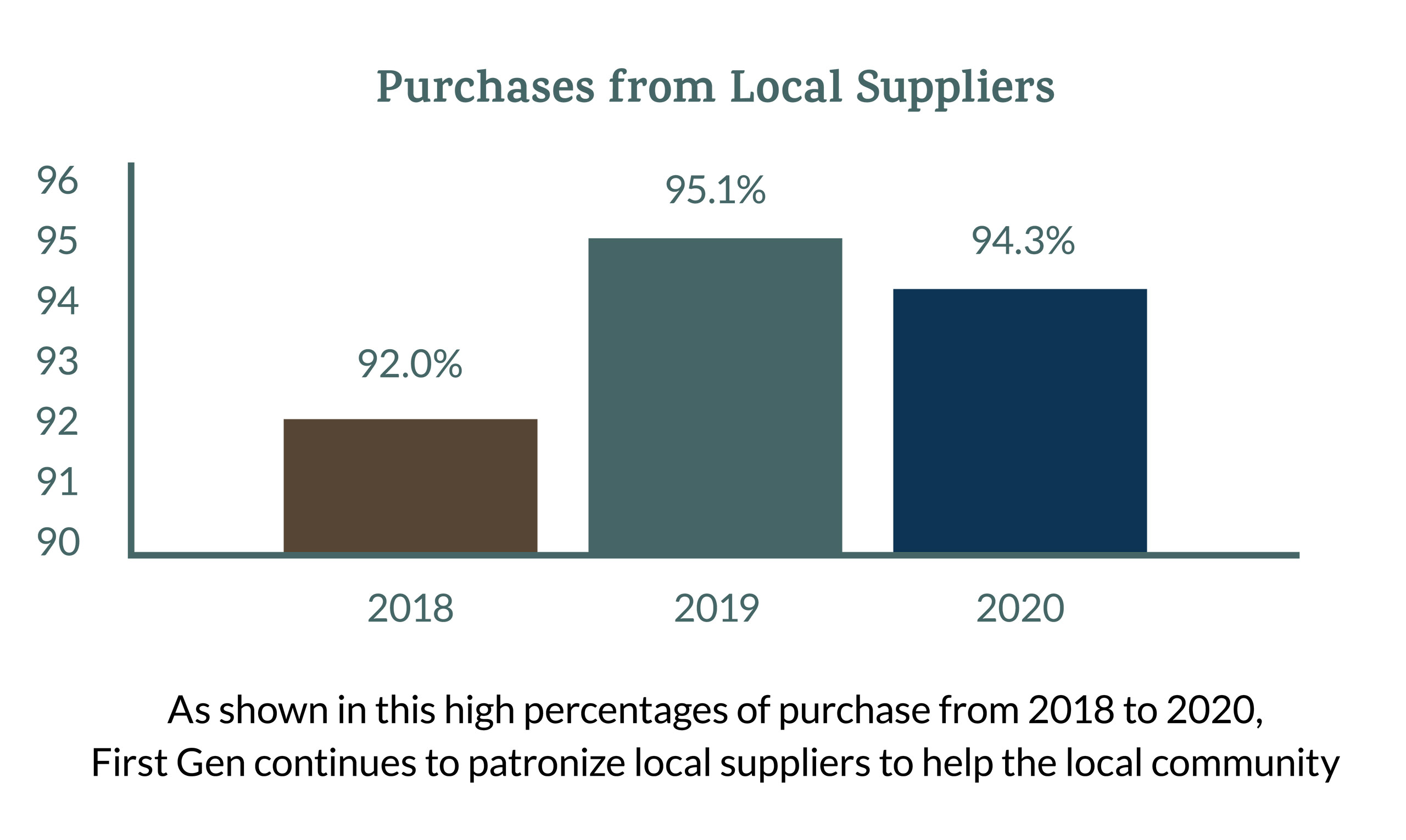
First Gen is committed to efficiently procuring the necessary products and services at the best possible value, ensuring prompt delivery, and addressing the needs of the business and support groups. Vendors are subject to accreditation and post-accreditation processes to check their legal existence, business legitimacy, and financial capability based on the accreditation type. In the Company's procurement practices, the team considers both locally-sourced and foreign- sourced materials. The Company’s procurement practices are more evident in the plant sites storing the procured items originating from the original equipment manufacturer (OEM) located in foreign countries. When foreign vendors have local counterparts or agents in the Philippines, the necessary goods are purchased from them. Other non-OEM goods are preferably bought from local vendors and the local community. In 2020, about 94.3 percent of the Company’s total purchases were from local suppliers.
“The Company carries out Occupational Health and Safety (OSH) processes and programs in its operations and complies with applicable laws and regulations.”
First Gen is also committed to ensuring the safety and health of all workers within its premises, and its contractors and outsourced service providers. The Company carries out Occupational Health and Safety (OSH) processes and programs in its operations and complies with applicable laws and regulations. Contractor assessments are done in three phases: a) pre-qualification and selection of contractors based on the Company’s environmental and OSH criteria; b) pre-job review of the contractors’ Environment, Safety, and Health (ESH) plans to check that these are adequate and appropriate; and c) ESH audits and inspections while work is in progress. These assessments not only validate the compliance of contractors with Philippine regulations and Company standards; these also influence them and their workers to maintain a safe and healthy work environment while fulfilling their tasks.
With the Contractor ESH Management system implemented by the Company, due diligence on the contractors is conducted based on the Company’s guideline and checklist. Out of the 47 contractors in 2020, 74.5 percent were assessed on the set environmental and social criteria. Contractors are required to submit an Environmental Management Plan specific to the rendered services, including waste management, and a Health and Safety Management Plan, including benefits provided to workers. To ensure that all expectations are complied with by the contractors, they are evaluated and given feedback based on their compliance and performance. About 10.6 percent of the total suppliers were identified to have potential negative environmental impact and social impact due to insufficient compliance with the Department of Environmental and Natural Resources’ (DENR’s) and Department of Labor and Employment’s (DOLE’s) requirements. These identified contractors agreed to implement the recommendations before their services are hired. The common findings include: a) non-submission of proof of compliance with government mandated benefits, and b) non-submission of required waste management plan.
To further guarantee the worker’s safety and well-being, they are required to follow company protocols, undergo the necessary ESH orientations, training and certifications depending on their type of work, and to participate in the Company’s emergency response drills. The orientation and training they receive include First Gen’s environmental orientation, OSH policies, the return-to-work protocols, and permit to work system. When the COVID-19 outbreak started, all contractors who continued to work within First Gen’s premises were required to follow the guidelines set by the government’s COVID-19 Inter-Agency Task Force (IATF) for the Management of Emerging Infectious Diseases resolutions and the Company’s protocols.
More than 800 workers rendering services on maintenance, security, and utility were provided with SIP facilities, and COVID-19 personal protective equipment (PPE). Clinics and medical stations were installed on sites to assist individuals with symptoms. The Occupational Health (OH) team from the Head Office and the sites ensure that the COVID-19 protocols of the contractor are aligned and consistent with the IATF guidelines and the Company’s protocols. Contractors are required to undergo the Real-Time Reverse Transcriptase- Polymerase Chain Reaction (RT-PCR) test prior to engagement and especially after coming from their communities and from their off-duties. After negative test results, SIP workers can enter the pre-SIP condition after 14 days as an additional security measure in case COVID-19 symptoms develop. Only the symptom-free contractors are eligible to stay in the SIP. Furthermore, health risk assessment is conducted to the worker before the antigen (Ag) testing is done. If a need is established, the Ag testing shall be done to the worker every two weeks for three cycles. Contracted workers who might have been exposed to or showing signs and symptoms of COVID-19 are advised for endorsement to their respective local government units for appropriate actions.
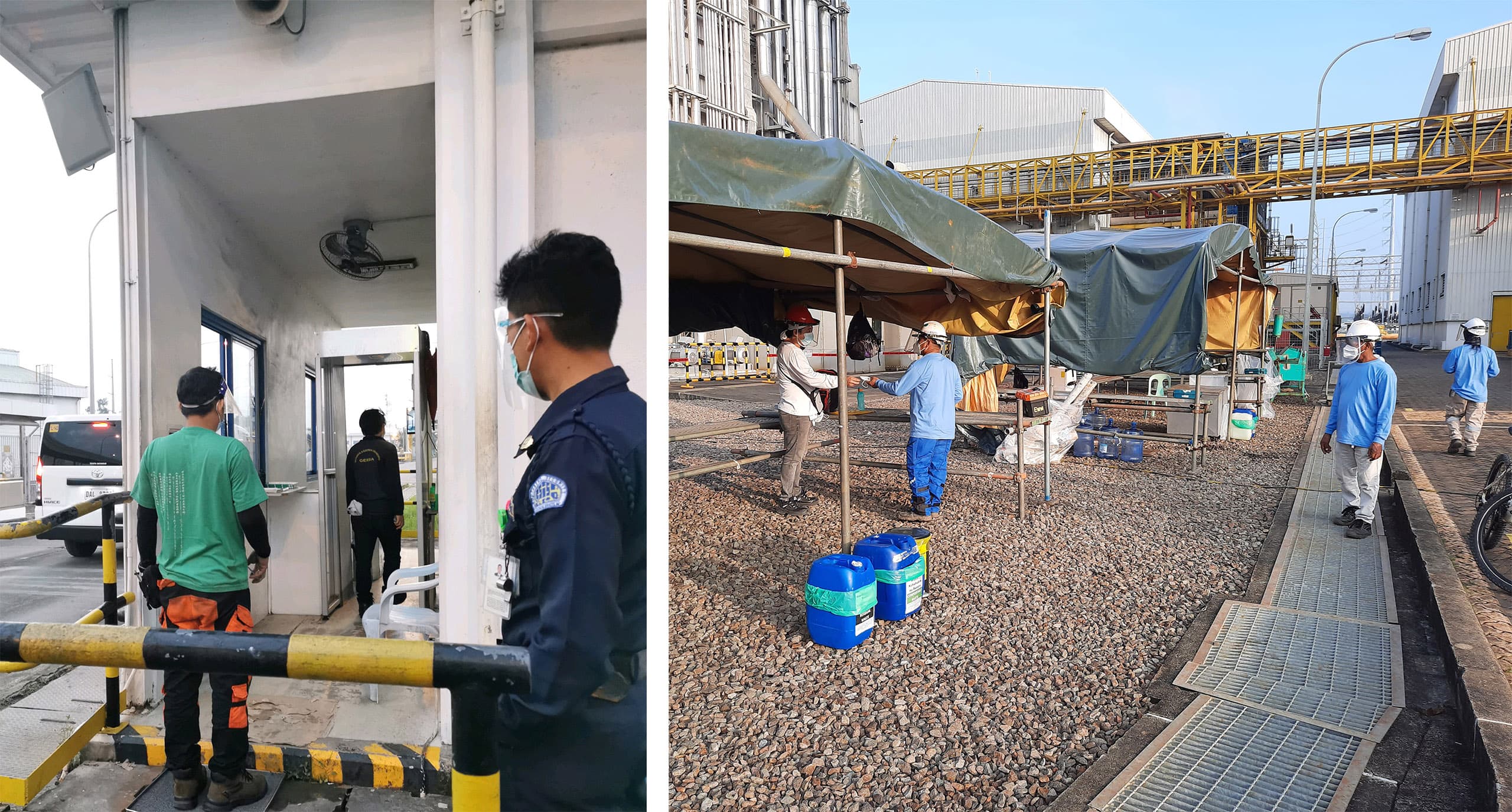
Workers required to follow the Return to work protocol in FGCEC
PARTNERING WITH THE COMMUNITIES
First Gen values its harmonious relations with the communities that allowed the Company to operate in their respective areas. In turn, the Company practices its Corporate Social Responsibility (CSR) principles and commitments through its CSR programs focused on education, livelihood, the environment, community health and safety, disaster response, and local culture. For the effective and efficient execution of these programs, the Company developed the CSR policy to guide its implementation. The CSR policy is conducted as follows:

Stakeholder Management
This process manages the relationship between the Company and stakeholders, where their participation is sustained throughout the life of the project. This strategic approach to stakeholder engagement allows the CSR department to continuously develop programs that address the stakeholders’ issues and needs. Communities and organizations are involved in decisions that may affect them and so they remain supportive of the Company.
Feedback and greivances raised by communities and corresponding actions are documented in the Stakeholder Log.

CSR Program Development and Management
The CSR department and the ComRel teams formulate CSR programs aligned with the Company’s priority areas, which, at the same time, benefits the partner communities and institutions. This process includes:
a) community mapping and social acceptability surveys done every three years; and
b) development, execution, monitoring, and reporting of CSR programs.

Donations and Sponsorship
Requests for donations and sponsorships across First Gen and its subsidiaries are covered by the Donations and Sponsorship policy. Only requests that pass the Program Criteria identified in the CSR and ComRel program will be approved and processed for release. If applicable, approved donations and sponsorships must be covered by a Memorandum of Agreement (MOA) to ensure that parties abide by their responsibilities in the project.

Employee Volunteerism
The Company encourages employees and their family members to participate in CSR activities.
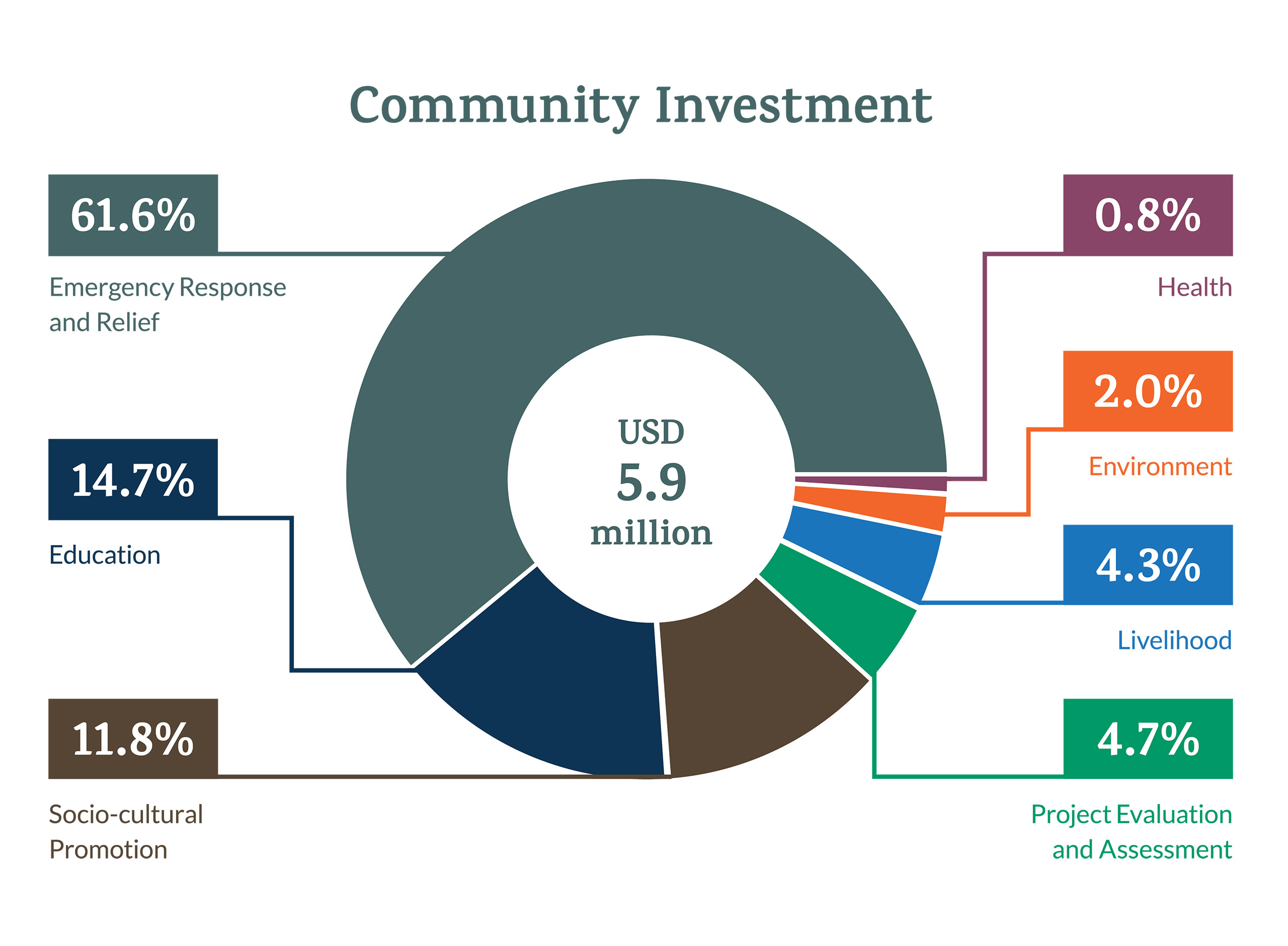
In 2020, First Gen provided COVID-19 assistance to the residents of its host communities and the host local government units (LGUs) through access to ER 1-94 funds. These funds are the Company’s mandated contributions for its community health, environmental, and social projects.
I. Response during disasters
The Company aids in educating and informing the community to be aware and prepared when disaster happens in the area. EDC sponsored the Municipal Youth Rescue Olympics in February 2020, which was participated by the Sangguniang Kabataan (youth council) of 11 barangays and students from 10 elementary schools in Ilocos Norte. In Leyte, EDC also produced and shared disaster readiness materials with the LGU and posted these in public areas. First Gen and its subsidiaries also conducted several relief operations for the communities affected by typhoons Rolly and Ulysses.

2,650 sacks of rice were distributed to families affected by typhoon Rolly in Albay, Sorsogon, Catanduanes, and Camarines Sur

2,826 households in host barangays in Albay, Sorsogon were given holiday packages
14,028 families affected by typhoon Ulysses were provided relief assistance in Batangas, Marikina, Samar, Bulacan and Cagayan
II. Promoting quality education
First Gen provides quality education and continuous learning opportunities to its partner communities to build their competencies and capacities for better employment opportunities. The Company program Brigada Eskwela continued to help students despite the temporary closure of schools due to the pandemic. Nearly 20,000 students from the different host barangays were given access to modular learning worth PHP2.1 million:
- Five schools from Batangas City
- 39 schools from Pantabangan and Carranglan towns in Nueva Ecija and Alfonso Castaneda, Nueva Vizcaya, and Maria Aurora towns in Aurora
- 23 schools from the towns of Manolo Fortich, Baungon, Libona, Impasug-ong and San Isidro in Bukidnon; and Jabonga town in Agusan Del Norte
In 2020, the Company enabled nine students from Batangas City to complete the work apprenticeship program (WAP) in partnership with Mitsubishi- Hitachi Power Systems. This initiative resulted in a 100 percent increase in income for the students who completed the program. Additionally, three college students received scholarships as part of the partnership between the Lopez Group Foundation, Inc. and Lyceum of the Philippines. Twelve Grade 12 students also received scholarships provided by the Foundation and its partnership with barangays Sta. Rita Karsada, Sta. Rita Aplaya and Bolbok in Batangas City. This scholarship program helped the scholars' families to save on education costs at approximately PHP35.0 thousand to PHP40.0 thousand.
Through FGHPC, there were 56 Grade 6 students from Kalayaan Elementary School, Masiway Elementary Schools, Sampaloc Elementary School, Pantabangan West Central School, and Lower Tuliy Elementary School in Pantabangan, Nueva Ecija granted with education incentives that helped cover the expenses of their families. Printers were also donated to the Company’s 38 host schools in partnership with the District of Pantabangan.
EDC’s SIKAT Program continuously provides financial and mentoring assistance to distinguished students from its host communities to give them access to quality tertiary education. From 2020 to 2021, EDC supported 110 college scholars enrolled in various known state universities and colleges. In partnership with ASUS, the Company realigned the scholar's stipend to provide the scholars with the appropriate distance learning items, such as pocket WiFis and laptops. In Leyte, school supplies and equipment, such as printers and toners, were donated to several partner schools through the Department of Education (DepEd). DepEd In Burgos, Ilocos Norte also received school supplies. Likewise, the 359 high school scholars in Negros Oriental collected a total of PHP319.0 thousand from their allowance to donate risograph machines and computer printers for the three partner schools in Valencia town.
Twelve SIKAT scholars graduated in 2020, increasing the program’s total sponsored scholars to 89 since 2011. This number inspires the Company to continue its service to the communities and elevate living standards through quality education.
III. Elevating lives of IP
First Gen adheres to FPH’s “Cultural Heritage and Indigenous Peoples (IP)” policy, which affirms the IP’s right to their territories, cultural integrity, and self- determination. Through its operating assets, First Gen supports various indigenous cultural communities in different areas of its operations, namely, the Maluyon tribe in Pantabangan, Nueva Ecija; the Mamanwa and Higaonon tribes in Agusan; and the Manobo tribe in Mt. Apo. Services include the construction of school facility, distribution of school supplies, conducting medical missions, and livelihood assistance. The host communities are also encouraged to participate in the Company's environmental programs to protect the forests and their ancestral domains. First Gen respects the cultural heritage, practices, and traditions of the IPs. Thus, the Company consults the IP-recognized leaders first before securing the “Free and Prior Informed Consent” required prior to beginning any project within their territories. As a result, First Gen has no incident of violation involving the rights of the indigenous people.
To support the Manobo-Apao Descendant of Ancestral Domains of Mt. Apo (MADADMA), EDC facilitates the documentation of the Obo- Manovu Indigenous Political Structure (IPS) for the registration of MADADMA as an Indigenous Political Organization (IPO). EDC also helps in preserving and promoting the IP culture by supporting the construction of the School of Indigenous Knowledge (SIK) in Magpet, Cotabato. Other assistance given to them include scholarship programs and the “Balik- Eskwela” program to provide financial assistance to students. EDC also supports livelihood initiatives for the MADADMA by providing funds that may be used in cash-for-work for the MADADMA Farm Tourism and Central Market farm tourism project. EDC also partners with the Kidapawan City Agricultural Office for technical assistance and marketing support for the community groups to improve their farm production, harvest, and sales.
SUPPORTING LOCAL GOVERNMENT UNITS (LGUs) IN MANAGING THE PANDEMIC
First Gen made an investment of PHP741.0 million in strengthening the capacity of the host LGUs and other vulnerable sectors of society in managing the effects of the pandemic. Several assistance programs were deployed primarily in the areas where the operating plants are located.
Through the ER 1-94, several projects amounting to PHP142.6 million were implemented in Batangas City, the host LGU of the power plants in FGCEC. The projects are as follows:
a) A temporary isolation facility was constructed and hotels were rented as temporary isolation facilities for suspected and confirmed COVID-19 cases.
b) COVID-19 tests such as rapid antigen tests and RT-PCR tests were provided.
c) PPEs, medicine, and medical equipment and supplies were given to the frontliners.
d) Disinfectants for sanitation operations were purchased.
e) Operation of a mobile market.
EDC on the other hand, deployed 20 container vans as temporary accommodation quarters for the medical frontliners and as hospital extension wards for host LGUs and partner hospitals and rural health units. EDC also donated RT-PCR machines, laminar flow and biosafety cabinets, and laboratory equipment to its partner LGUs, hospitals and the Department of Health (DOH). Four molecular testing centers with an aggregate amount of PHP45.0 million were completed and commissioned to Ormoc City Negros Oriental, Negros Occidental, and Ilocos Norte. These facilities have improved the turnaround time of testing results to one to two days from the usual one-week waiting time. A donation of PHP4.2 million for the ongoing refurbishment of the RITM-accredited COVID-19 testing laboratories was also given to the Department of Health (DOH) in Bicol region. The other supported molecular diagnostic centers in Iloilo, Kidapawan City, and Cotabato started construction in 2020 and will be completed within the first half of 2021.
Food and Medical Support for the Host Communities

5,790 individuals in Pantabangan and Carranglan, Nueva Ecija, Alfonso Castaneda, Nueva Vizcaya, and Maria Aurora, Aurora were provided PPEs, medicine, and COVID-19 kits
61 households in two barangays provided with COVID-19 kits and eight institutions provided with PPEs in barangays Damilag and Agusan Canyon in Manolo Fortich, Bukidnon
6,600 rapid antibody test (RAT) kits donated to various LGUs in Leyte and Samar, Negros Oriental, Bicol, Kidapawan, and Ilocos Norte.
Three barangays, three rural health units and one hospital in barangays Imbatug and Liboran in Baungon, Bukidnon; and barangay Kiliog in Libona, Bukidnon; and the municipality of Impasug-ong, Bukidnon were provided with PPEs
26,722 families in Batangas City, Pantabangan, Nueva Ecija, Marikina, Marinduque were provided relief assistance
Four barangays (Baleguian, Maraiging, Cuyago and Bangonay) in Jabonga, Agusan del Norte were provided with medicine supplies
4,490 sacks distributed to 24,964 households in Albay, Sorsogon Leyte, Negros Oriental, Cotabato and Ilocos Norte
1,568 households benefited from short-term livelihood projects that include backyard farming, tilapia production, piggery, livestock dissemination, coffee seedlings collection, and face mask production
First Gen contributed to the Lopez Group’s support to the project of the Department of Transportation (DOTr), Philippine Ports Authority (PPA), and Philippine Coast Guard (PCG) in retrofitting the Eva Macapagal Super Terminal into a COVID-19 treatment center. The facility has 211 cubicles divided into zones to separate patients with mild, advanced, and severe COVID-19 infections. Support was also given to the Port Capinpin Quarantine Facility in Bataan. The facility has a 124-bed capacity including 15 cubicles for high-risk individuals. The Lopez Group also donated a Stage 3 ambulance to DOTr. The total financial support for these projects amounted to PHP101.7 million.
First Gen also partnered with FPH and First Balfour in retrofitting the MetroTent Ortigas into a 120-bed temporary shelter for the employees of The Medical City hospital. In collaboration with ABS-CBN, the Company donated PHP46.0 million worth of new machines and lab equipment to expand the COVID-19 testing capacity of Philippine General Hospital in Manila.
Donation of printers to 38 host schools in Pantabangan, Nueva Ecija
2,650 sacks of rice were distributed to families affected by typhoon Rolly in Albay, Sorsogon, Catanduanes, and Camarines Sur
2,826 households in host barangays in Albay, Sorsogon were given holiday packages
14,028 families affected by typhoon Ulysses were provided relief assistance in Batangas, Marikina, Samar, Bulacan and Cagayan