
First Gen’s manufactured capital is composed of physical, material, and technological assets, such as power plants, equipment, tools, and infrastructure assets. All of these are used together to deliver the Company’s main service: power generation. First Gen owns and operates a total of 30 power projects all over the Philippines. These projects were either acquired or constructed through turnkey Engineering, Procurement, and Construction (EPC) contracts.
All assets are managed and maintained through value preservation, high economic performance, safety, reliability, cost-effectiveness, and sustainability of operations. The Company conducts regular planning, maintenance, and monitoring programs to provide reliable and dispatchable power. Periodic assessments and reviews on business and environmental risks are done for each asset, overseen by the Senior Management Risk Review Committee (SMRRC) and the Board Risk Oversight Committee (BROC). The Company developed and implemented appropriate measures to address or mitigate risks and to ensure the resilience of assets and business continuity in situations brought about by climate change.
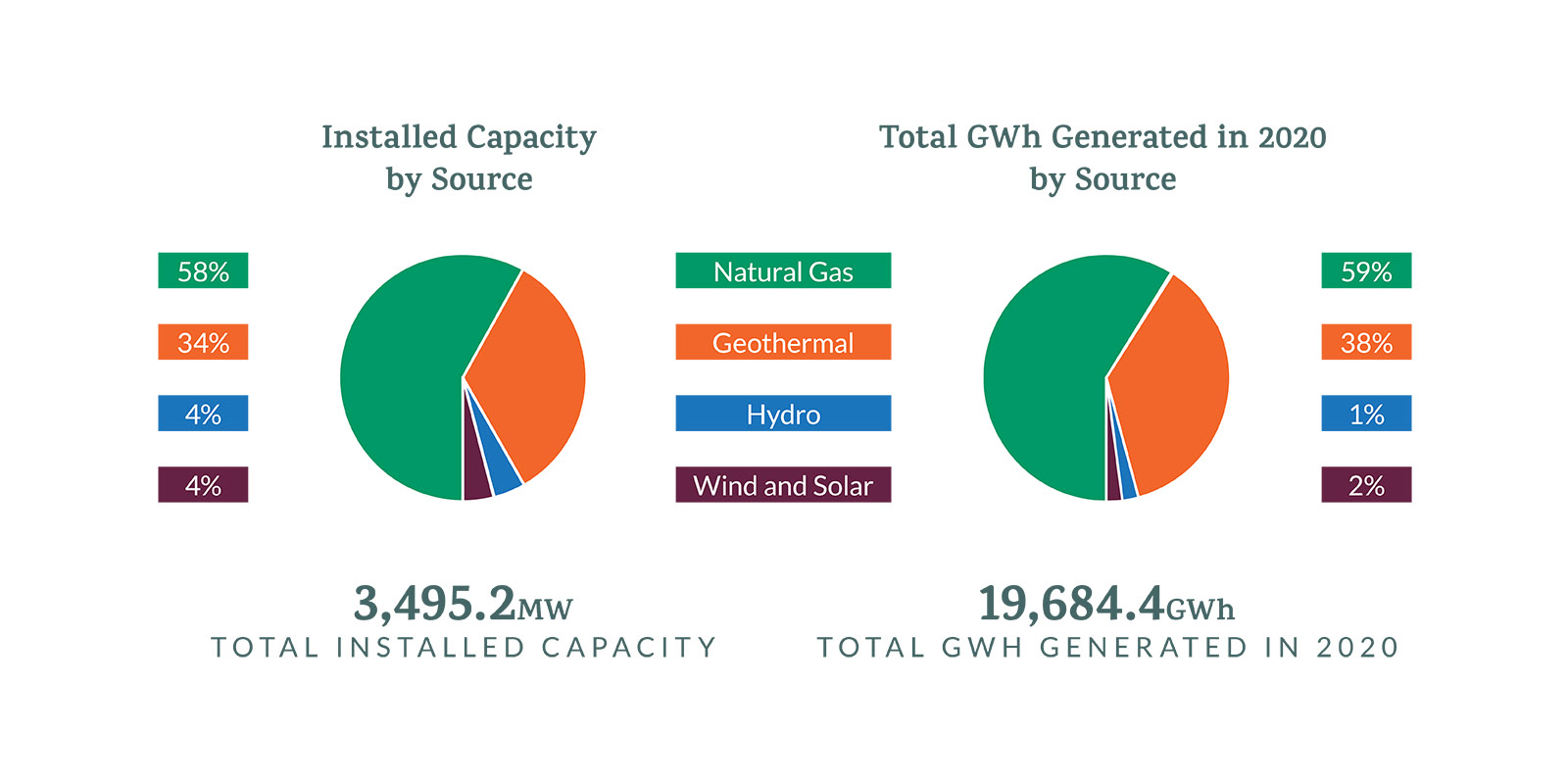
| NUMBER OF FIRST GEN PROJECTS BY SOURCE | ||
|---|---|---|
| SOURCES | NO. OF PROJECTS | CAPACITY (MW) |
| Natural Gas | 4 | 2,017.0 |
| Geothermal | 12 | 1,181.8 |
| Hydro | 3 | 134.4 |
| Solar | 10 | 12.0 |
| Wind | 1 | 150.0 |
MATERIAL TOPICS ON OPERATIONAL CAPITALS
Power Supply Availability
First Gen maintains its power plants, equipment, tools, and other building infrastructure through value preservation, high economic performance, safety, reliability, cost-effectiveness, and sustainability of operations. First Gen’s three combined cycle natural gas-fired power plants— Santa Rita, San Lorenzo, and San Gabriel—are all under a third-party O&M agreement with a service provider—Siemens Energy, Inc. (SEI), formerly Siemens Power Operations, Inc. (SPOI). All purchases for the operations and maintenance of these power plants are done by the service provider. On the other hand, all other power plants are managed, operated, and maintained by the Company’s technically capable and skilled personnel.
Immediate actions were carried out to address the effects of several natural calamities experienced at the FGCEC. These are the Taal Volcano eruption in January 2020 and typhoons in November 2020. The Taal Volcano eruption resulted in grid constraints that limited the dispatch of the power plants. The presence of volcanic ash forced the units operating at that time—the Santa Rita, San Lorenzo, and Avion Units—to operate at minimum load as a proactive measure to protect the gas turbines. The pre-emptive measures averted possible downtime due to equipment failure.
As part of the dispatch protocol during the typhoons that hit Batangas, e.g., Typhoon Rolly and Typhoon Ulysses, some units were shut down in coordination with the System Operator, as a pre-emptive measure. After the passage of the typhoons, the units were synchronized back to the grid in coordination with the System Operator.
First Gen proactively manages its risks by preparing contingencies to minimize the disruption to operations due to intense rainfall and more frequent stronger typhoons. The Company prepares contingencies to remain ahead of the curve and to keep interruption costs down. The Company is also enhancing its “strategic spares” program and has begun exploring innovative and resourceful designs for its plant facilities in anticipation of the "new normal" weather conditions. Although the risk of disruption is still present, the Company continues to develop mitigation measures such as:
- Installing flood control schemes for the existing power facilities of the Company and proactively designing facilities to withstand greater wind speeds;
- Ensuring that buildings are designed according to the National Structural Code of the Philippines (NSCP);
- Conducting earthquake assessments
Moreover, First Gen works in cooperation with contractors to ensure the continued operations of its plants during these operational disruptions. The Company has likewise secured insurance for all its plants, covering losses due to natural catastrophes, including earthquakes and typhoons.
With the COVID-19 outbreak in the 1st quarter of 2020, the Business Continuity Management (BCM) was activated and only a skeletal workforce sufficient to monitor and continue the operations of each power plant was deployed. First Gen continued its partnership with its maintenance providers to ensure the reliability of the power plants and equipment and to carry out the planned annual maintenance.
With the COVID-19 outbreak in the 1st quarter of 2020, the Business Continuity Management (BCM) was activated and only a skeletal workforce sufficient to monitor and continue the operations of each power plant was deployed. First Gen continued its partnership with its maintenance providers to ensure the reliability of the power plants and equipment and to carry out the planned annual maintenance.
First Gen is also migrating to a more secure and resilient built-for-purpose information technology (IT) communication network infrastructure. Over the past year, the following were initiated:

Signed more managed services and maintenance of IT networks and infrastructure;

Improved IT backup and disaster recovery plans;

Increased reliability of internet access by installing a fiber optic backbone, and increasing bandwidth subscriptions; and,

Started integrating the Company’s IT and operational technology networks.
Access and Affordability
First Gen provides retail electricity and specialized energy solutions to all customers through low-carbon power supply and equipment and customized value-adding services. The Company emphasizes the advantages of sourcing power from First Gen by highlighting its flexible pricing structure and emissions avoided from a power- generating portfolio of natural gas, geothermal, hydro, wind, and solar technologies. The renewable sources have zero-rated Value Added Tax advantages as provided for under the Philippine Renewable Energy Act of 2008.
The Company has three Retail Electricity Supply licenses to efficiently cover the various commercial and industrial electricity users. It has significantly increased its engagement with customers from key industries, particularly those considered as like-minded companies with similar values as First Gen. Customers are acquired through the submission of personalized proposals catering to customers’ specific energy needs, such as power bill savings, sourcing through renewable energy, and energy management services, to name a few. Annual customer satisfaction surveys displayed high satisfaction ratings from existing customers; thus highlighting the ease and quality of working with the Company, good relationship and open communications with dedicated marketing officers, and the Company’s diligent consideration of its customers as key reasons for customer retention and delight. Other efforts to increase the Company’s customer base are through digital marketing initiatives, institutional marketing, and referral programs, which incentivize current customers of the Company to refer First Gen to whoever may need energy solutions.
The Santa Rita and San Lorenzo plants sell their power to Meralco under 25-year Power Purchase Agreements (PPA) with an 83 percent take-or-pay Minimum Energy Quantity (MEQ) arrangement. San Gabriel likewise sells its full capacity to Meralco under a six-year Power Supply Agreement (PSA) covering 2018 to 2024. Half of the Avion plant’s capacity is contracted under a firm Ancillary Services Procurement Agreement (ASPA) with the NGCP. The other half of Avion’s capacity is sold to the WESM, particularly during peak periods. Avion can also offer this capacity as ancillary services to NGCP on a non-firm basis.
EDC’s steam and electricity sales are supported by medium-term to long-term offtake agreements in various forms. EDC has three 25-year PPAs with the National Power Corporation (NPC) covering EDC’s Unified Leyte and Mindanao Geothermal Power Projects (Mindanao I and Mindanao II). Its subsidiaries, namely Green Core Geothermal Inc. (GCGI), Bac-Man Geothermal Inc. (BGI), First Gen Hydro Power Corporation (FG Hydro), and Unified Leyte Geothermal Energy Inc. (ULGEI), hold offtake agreements in the form of power supply agreements with various customers, particularly electric cooperatives. BGI holds a Retail Electricity Supplier (RES) license effective for five years from February 2017 until February 2022 and has offtake agreements in the form of Retail Supply Contracts (RSCs) with contestable customers.
Burgos Wind and Burgos Solar were issued a Feed-in-Tariff (FIT) Certificate of Compliance (COC) by the Energy and Regulatory Commission (ERC), entitling them to an applicable FIT rate, subject to adjustments as approved by the ERC for the entire duration of their FIT eligibility period.
EDC, GCGI, and FG Hydro likewise offer their capacities as ancillary services to NGCP under their respective ASPA contracts. The generated electricity above contracted levels is sold to the WESM.
“Annual customer satisfaction surveys displayed high satisfaction ratings from existing customers; thus highlighting the ease and quality of working with the Company.”
OPERATIONAL INDICATORS
Most of First Gen’s assets continued to supply power to the grid throughout 2020, however, there was a decrease in total actual energy generation largely due to the lower demand caused by the pandemic restrictions. Other factors that impacted the Company’s total generation were:
- The unexpected generator issue experienced by the San Gabriel combined-cycle gas turbine (CCGT) power plant last September 2020 required the plant to go on a forced outage for an extended period for its repair. While the repair was challenging due to the pandemic, the Company’s resourcefulness and collaboration with several parties successfully brought the plant back online by February 2021.
- Higher unplanned outages in the geothermal platform because of the extended outages of plants in Leyte and Negros. The main factors for these are: a) the generator exciter issue of Upper Mahiao, and b) the extended outage of Palinpinon 1 and Tongonan.
- Lower water elevation of the Pantabangan Dam resulted in a lower generation of the hydro platform. Lower water elevation is attributed to the drier than expected rainy season from June to September. While water elevation improved in the last quarter of the year, this was not enough to make up for the decrease in the second and third quarter. Instead, this water level increase has made the hydro platform well-prepared and ready to generate more power in 2021.
| NATURAL GAS | |||||||||||||
|---|---|---|---|---|---|---|---|---|---|---|---|---|---|
| SANTA RITA | SAN LORENZO | SAN GABRIEL | AVION | ||||||||||
| 2020 | 2019 | 2018 | 2020 | 2019 | 2018 | 2020 | 2019 | 2018 | 2020 | 2019 | 2018 | ||
| Actual Energy Generation (GWh) |
6,539.3 | 7,188.0 | 7,259.4 | 3,434.6 | 3,732.5 | 3,606.7 | 1,425.7 | 2,758.3 | 2,198.4 | 127.8 | 196.8 | 123.30 | |
| Net Capacity Factor (%) |
68.7 | 75.6 | 75.8 | 69.4 | 76.3 | 73.5 | 38.3 | 75.4 | 61.0 | 15.0 | 23.2 | 14.50 | |
| Availability (%) | 93.1 | 95.5 | 96.4 | 93.7 | 95.4 | 94.2 | 60.2 | 92.6 | 90.5 | 90.1 | 65.8 | 89.00 | |
| Reliability (%) | 97.5 | 98.5 | 98.8 | 96.3 | 98.2 | 97.5 | 70.5 | 93.2 | 94.1 | 91.3 | 70.3 | 93.9 | |
| Planned Outage (hours) |
1,306.6 | 839.3 | 802.4 | 139.8 | 464.9 | 428.2 | 1,366.5 | 0.0 | 335.4 | 31.7 | 516.7 | 672.0 | |
| Unplanned Outage (hours) |
657.1 | 367.0 | 416.3 | 633.8 | 310.4 | 428.6 | 2,112.8 | 573.8 | 492.1 | 96.1 | 4,923.1 | 971.2 | |
| Generation Efficiency (%) |
52.8 | 54.4 | 54.0 | 55.1 | 55.2 | 54.6 | 55.2 | 57.9 | 56.8 | 30.9 | 38.0 | 37.0 | |
| GEOTHERMAL | ||||||||||
|---|---|---|---|---|---|---|---|---|---|---|
| BACMAN | UNIFIED LEYTE | TONGONAN | ||||||||
| 2020 | 2019 | 2018 | 2020 | 2019 | 2018 | 2020 | 2019 | 2018 | ||
| Actual Energy Generation (GWh) |
1,025.1 | 1,066.8 | 1,061.6 | 3,389.8 | 3,470.2 | 3,277.7 | 929.9 | 901.6 | 635.3 | |
| Net Capacity Factor (%) |
87.6 | 91.5 | 93.6 | 67.6 | 72.7 | 70.1 | 93.8 | 106.5 | 80.7 | |
| Availability (%) | 95.7 | 93.4 | 96.0 | 93.4 | 85.3 | 86.8 | 95.7 | 98.8 | 92.3 | |
| Reliability (%) | 96.4 | 99.1 | 98.4 | 94.2 | 87.3 | 87.6 | 96.4 | 99.4 | 98.7 | |
| Planned Outage (hours) |
431.9 | 368.1 | 662.1 | 575.8 | 2,350.6 | 953.6 | 213.3 | 308.0 | 1,699.6 | |
| Unplanned Outage (hours) |
963.9 | 561.8 | 634.4 | 12,411.6 | 18,385.8 | 5,189.4 | 1,078.4 | 78.6 | 315.6 | |
| GEOTHERMAL | ||||||||||
|---|---|---|---|---|---|---|---|---|---|---|
| PALINPINON | NASULO | MINDANAO | ||||||||
| 2020 | 2019 | 2018 | 2020 | 2019 | 2018 | 2020 | 2019 | 2018 | ||
| Actual Energy Generation (GWh) |
1,110.2 | 1,201.1 | 1,193.5 | 320.9 | 308.9 | 304.9 | 693.8 | 716.0 | 791.8 | |
| Net Capacity Factor (%) |
83.0 | 84.4 | 82.9 | 82.6 | 78.2 | 78.0 | 79.0 | 79.1 | 86.1 | |
| Availability (%) | 89.6 | 97.0 | 98.0 | 99.8 | 95.8 | 99.9 | 99.5 | 98.6 | 96.4 | |
| Reliability (%) | 90.3 | 99.1 | 99.4 | 99.8 | 99.2 | 99.9 | 99.5 | 99.7 | 95.9 | |
| Planned Outage (hours) |
288.6 | 496.1 | 537.6 | 0.00 | 183.2 | 0.0 | 0.0 | 351.3 | 552.3 | |
| Unplanned Outage (hours) |
3,999.3 | 2,011.7 | 445.2 | 21.5 | 161.3 | 42.0 | 74.5 | 194.5 | 85.4 | |
| HYDRO | ||||||||||
|---|---|---|---|---|---|---|---|---|---|---|
| PANTABANGAN | MASIWAY | AGUSAN | ||||||||
| 2020 | 2019 | 2018 | 2020 | 2019 | 2018 | 2020 | 2019 | 2018 | ||
| Actual Energy Generation (GWh) |
255.2 | 345.4 | 277.2 | 39.6 | 47.3 | 45.0 | 9.7 | 8.6 | 11.2 | |
| Net Capacity Factor (%) |
24.2 | 32.9 | 26.4 | 37.6 | 45.1 | 42.8 | 68.9 | 61.2 | 80.0 | |
| Availability (%) | 89.6 | 90.8 | 84.3 | 90.0 | 87.3 | 90.9 | 99.1 | 94.5 | 95.5 | |
| Reliability (%) | 99.9 | 99.7 | 100.0 | 100.0 | 99.8 | 100.0 | 99.8 | 95.0 | 99.7 | |
| Planned Outage (hours) |
1,654.5 | 1,538.5 | 2,619.5 | 861.9 | 1,074.0 | 791.3 | 58.8 | 42.7 | 362.3 | |
| Unplanned Outage (hours) |
169.4 | 61.0 | 277.2 | 14.8 | 38.9 | 9.0 | 18.4 | 438.1 | 28.0 | |
| WIND AND SOLAR | ||||||||||
|---|---|---|---|---|---|---|---|---|---|---|
| BURGOS WIND | BURGOS SOLAR | SOLAR ROOFTOP | ||||||||
| 2020 | 2019 | 2018 | 2020 | 2019 | 2018 | 2020 | 2019 | 2018 | ||
| Actual Energy Generation (GWh) |
367.0 | 340.9 | 376.0 | 10.2 | 9.5 | 9.8 | 5.6 | 6.7 | 5.6 | |
| Net Capacity Factor (%) |
27.9 | 25.9 | 28.6 | 19.3 | 16.0 | 17.7 | 14.6 | 14.8 | 13.9 | |
| Availability (%) | 97.9 | 98.7 | 99.6 | N/A | N/A | N/A | N/A | N/A | N/A | |
| Reliability (%) | N/A | N/A | N/A | 71.5 | 71.8 | 70.5 | 65.9 | 71.8 | 78.3 | |
| Planned Outage (hours) |
28.8 | 35.2 | 33.4 | 0.0 | 0.0 | 0.0 | 0.0 | 0.0 | 0.0 | |
| Unplanned Outage (hours) |
13.4 | 4.6 | 15.0 | 362.8 | 797.3 | 636.8 | 567.7 | 0.0 | 0.0 | |
2020 PROJECTS AND ACCOMPLISHMENTS
First Gen executed its 2020 projects and activities with the renewed mission and purpose in mind. As such, all the projects for each of the platforms have identified the opportunity it is leveraging and the key capability that it is applying and developing.
| PROJECT | DESCRIPTION | OPPORTUNITY | CAPABILITY |
|---|---|---|---|
| NATURAL GAS | |||
| Avion Ancillary Services Procurement Agreement | In June 2020, Avion was able to fully operationalize its ASPA of up to 45-MW Firm and up to 45-MW Non- Firm Regulating Reserve with NGCP, providing flexible support to the grid, which helps ensure energy security. Through this contract, Avion can stabilize its revenues, while providing a crucial grid function. | Capture Demand | Holistic Customer Understanding and Influence |
| Interim Offshore Terminal (IOT) Liquefied Natural Gas Project | The Company continues to progress and accomplish significant milestones in the development of the IOT LNG project, which will not only sustain the use of natural gas, but also help to further develop the natural gas industry in support of the development of intermittent renewables. | Capture Demand | Market Driven Solutions |
| Continuous Responsible Operations of Existing Natural Gas Power Plants | The Company’s priority for its existing natural gas assets is to operate them responsibly, enabling them to continue to generate affordable and reliable electricity, while minimizing emissions. First Gen is continuously working to limit emissions throughout its operations and will seek to utilize new technology to further improve its ability to detect and prevent any such emissions. The Company also remains abreast of technological advancements including those that may help to decarbonize its gas portfolio. | Decarbonize Platforms | Decarbonization Advocacy Leadership and Strong Project Development and Asset Management |
| GEOTHERMAL | |||
| Binary Plants |
The Palayan Bayan, a 29-MW binary plant, is in its next phase of development after awarding its engineering, procurement, and construction (EPC) contract to First Balfour, Inc. The target completion of the project is in 2022. The Company also expects construction to begin on the 3.6-MW Mindanao 3 binary plant in the first quarter of 2021. The addition of binary plants to existing geothermal assets maximizes the geothermal steam it harnesses and boosts its generation. |
Capture Demand | Strong Project Development and Asset Management |
The Company continues to pursue the following projects, which are in various stages of pre-planning, development, and permitting:
| PROJECT NAME | DESCRIPTION |
|---|---|
| NATURAL GAS | |
| Santa Maria Power Plant | The development of an approximately 1,200-MW CCGT power plant. |
| Small-Scale LNG | Using the IOT LNG project as a hub, the Company will explore the development of Small-Scale LNG opportunities throughout the many islands of the Philippines. Small-Scale LNG can be used to supply natural gas power plants with relatively smaller capacities that can provide reliable and flexible localized power by being embedded into areas that centralized grids may have difficulty reaching (e.g. islands, off-grid areas, and industrial parks). |
| HYDROELECTRIC | |
| Aya Project | The development of a 100-MW to 120-MW Pumped-Storage Hydro Power facility that utilizes the Pantabangan and Masiway reservoirs as upper and lower reservoirs, respectively. |
| Bubunawan, San Isidro, Puyo, and Tagoloan Projects | Various run-of-river hydro projects in Mindanao to augment power supply in the Mindanao Grid and take advantage of renewable energy markets such as Feed-in-Tariff, Renewable Energy Market, Green Energy Option Program, and Green Energy Auction Program. |
| GEOTHERMAL | |
| 20-MW Tanawon Geothermal Power Plant | A proposal for a 20-MW geothermal power plant at Barangays Bulabog and Capuy, Sorsogon City, Sorsogon inside the Bacon-Manito concession area. |
| 36-MW Mahanagdong Geothermal Brine Optimization Power Plant | A proposal for the construction and operation of the Mahanagdong Geothermal Brine Optimization Plant at Barangay Milagros, Kananga Leyte that will enable the optimization of energy production to utilize the heat from geothermal brine through a binary plant technology. |
IMPACT OF THE PANDEMIC TO OPERATIONS
While First Gen’s plants continued to supply power throughout the different levels of community quarantine in 2020, operations had to adjust and quickly adapt to the restrictions imposed. One of the significant changes experienced was limiting the number of people on site. When the community quarantine was announced, the Company immediately implemented its BCM plan and enforced a work-from-home arrangement for all non-critical employees. Mission-critical personnel— those who were crucial in plant and market operations—were identified and were sheltered on-site as travel was limited and increased the exposure to the virus.
The Company arranged shelter-in-place accommodations across all its sites to ensure the continuity of its operations and to further guarantee the safety and welfare of its workers. In FGCEC, First Gen invested in a Workers’ Camp to provide accommodations to employees and contractors to lessen the pandemic’s impact on on- going projects and operations. Preventive measures that adhered to government regulations were also implemented in all the sites.
The pandemic affected plant maintenance as well, as movement restrictions made executing maintenance activities especially challenging. This was mitigated by closely coordinating with operations and maintenance partners and by monitoring developments in restrictions announced by the government to ensure that all guidelines were met.
Progress on our Interim Offshore LNG Project
The Company moves ahead with the development of its IOT LNG project that will ensure reliable fuel supply beyond the exhaustion of the Malampaya gas field. Below are the significant milestones that the project has achieved despite the restrictions due to the pandemic:
MARCH 2020
Submitted application for a Permit to Construct, Expand, Rehabilitate, and Modify (PCERM) to the Department of Energy (DOE).
SEPTEMBER 2020
Received the PCERM from DOE.
OCTOBER 2020
Entered into a Joint Cooperation Agreement (JCA) with Tokyo Gas.
Issued a Binding Invitation to Tender or the Charter of a Floating Regasification and Storage Unit (FSRU) for the IOT project, to which four experienced bidders participated.
Awarded construction contract to First Balfour for the construction of a shelter-in-place camp that will house up to 375 construction workers on commencement of construction of the IOT project at the site, which is expected to commence in April 2021.
NOVEMBER 2020
Awarded the EPC contract to McConnel Dowell for the IOT Project. A Notice to Proceed (NTP) was also issued indicating that the project is moving to its construction phase.
DECEMBER 2020
Announced three preferred tenderers to continue to the next stage of binding tender process for the charter of an FSRU for the IOT project.