
First Gen identifies and assesses the potential risks and feasible opportunities that underpin value creation. Based on these assessments, the Company designs and executes action plans aimed at addressing these risks.
OUR RISKS AND MITIGATING MEASURES
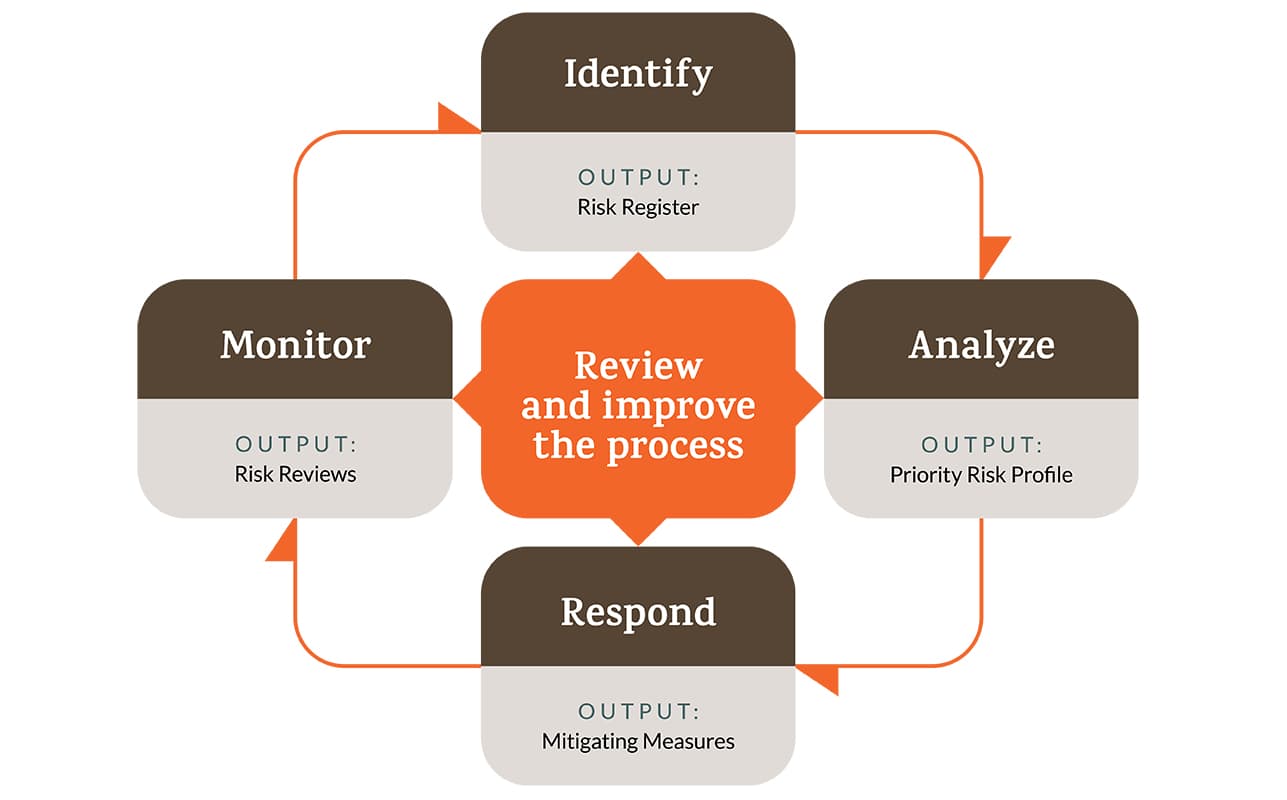
In reviewing and classifying the risks affecting the Company, First Gen goes through a regular comprehensive risk management process covering all operating plants, projects, and support units. Identification of critical risks and development of the appropriate mitigation plans are embedded in this process based on the assigned ratings. Risks classified as top risks are regularly reported to senior management and the Board Risk Oversight Committee (BROC). The Company’s top risks are:
| EXTERNAL ENVIRONMENT RISKS | MITIGATING MEASURES |
|---|---|
|
PANDEMIC RISK The on-going COVID-19 pandemic has far reaching implications affecting the Company’s operations, its workforce, its market, and its earnings. |
The company has:
|
|
COMPETITION RISK Amid the drop in energy demand due to the pandemic, competitors continue to expand capacity and vie for the same contracts. |
|
|
POLITICAL AND REGULATORY RISKS The regulatory landscape in the power and energy industry remains challenging as regulatory directives are dynamic, still evolving, and continue to confront the constraints posed by the COVID-19 pandemic. |
|
|
FUEL SUPPLY RISK Operations are highly dependent on:
|
|
|
EXPOSURE TO NATURAL CATASTROPHES Climate change has been observed to lead to climate variability and extreme weather, and consequently, the higher probability and intensity of natural disasters. |
|
| BUSINESS ACTIVITIES/OPERATIONS RISKS | MITIGATING MEASURES |
|---|---|
|
PLANT & EQUIPMENT RELIABILITY
|
|
|
CYBERSECURITY RISK There is increasing dependence on information systems, plant modernization, and construction of new plants with increasing dependence on automation and internet-linked machinery and equipment. |
|
|
FINANCIAL RISKS
|
|
TCFD AS A GUIDE IN PREPARING FOR CLIMATE CHANGE IMPACTS
Climate change is a major concern of any organization. For businesses, it may lead to an increase in the cost of operation or irreversible impacts on the earth where no business can thrive. Thus, First Gen, along with the FPH Group, manages the risks and opportunities climate change poses in its operations and finances. Additionally, the Company empowers its host communities with information on climate scenarios for them to implement adaptation actions.
The parent company, FPH, referenced First Gen's climate change management planning on the prescriptions of the Task Force on Climate-related Financial Disclosures (TCFD) in 2020, for a systemic assessment of climate change's impacts. The TCFD protocol was established by the Financial Stability Board to develop voluntary and consistent climate- related disclosures for transparency and to help companies and funders efficiently allocate capital to the transition to a low carbon economy as envisioned in the Paris Climate Agreement of 20151.
FPH recognizes, due to its diverse businesses, that climate-related factors vary based on the business unit's location and the nature and scale of their respective operations. Thus, FPH created a unified process at the conglomerate level with different strategies implemented by the subsidiaries. OML Center, in consultation with subsidiaries, prepared a unified report on climate-related information so the results can be correlated better with the total business activities and circumstances.
Process
Following the FPH TCFD road map, First Gen aligned its activities to complement the FPH initiatives.
| TCFD CORE ELEMENTS | WHAT FPH HAS DONE | WHAT FIRST GEN HAS DONE |
|---|---|---|
|
Climate Governance |
|
|
|
Strategy |
|
|
|
Risk Management |
|
|
|
Metrics and Targets |
For identification based on the foregoing processes. |
For identification based on foregoing processes. |
Progress in 2020
In 2020, FPH, with the assistance of the Oscar M. Lopez Center for Climate Change Adaptation and Risk Management Foundation Inc., completed the climate scenario analysis for the conglomerate’s 30 business unit locations. The climate scenario analysis explores how climate change might impact the organization over time. It uses the Representative Concentration Pathway (RCP) or the projected cumulative concentration of GHG emissions that causes global warming.
The study covers the decadal scenarios of 2030, 2050, and 2090 downscaled to RCP 8.5 and RCP 4.5. The RCP 8.5 is a “high emissions scenario” or business as usual where there is no policy reform nor measure to stop GHG emissions. The RCP 4.5 is an “intermediate emissions scenario” where emissions will slightly increase but will start to decline by 2040. These two pathways were selected because currently, the country is still dependent on coal with no set energy transition plan. Although, there were recommendations from various sectors in late 2020 to develop one soon. The First Gen business unit locations covered in the study and the climate scenarios by 2050 are shown below.
First Gen Sites Climate Scenarios by 2050
Click on a location to view more details
First Gen Sites
Climate Scenarios
by 2050
Click on a location to view more details





Climate change has been mainstreamed in the Company’s enterprise risk management activities since 2012 and adaptive measures are done to address these climate change conditions. For the past 10 years, the prevailing climate scenarios at the First Gen sites consist of high rainfall during the rainy season, rising sea levels, and more frequent bouts of El Niño. Below are the existing measures of the Company to adapt to the effects of climate change:
- Typhoon-proofing and reinforcement of power plant structures to withstand 300 kilometers per hour (kph) speed wind, as well as increased plant stability against earthquakes;
- Upgrading of plant equipment such as cooling towers upgraded from wood to Fiber Reinforced Plastic (FRP) to make them more resistant to wind, earthquakes, and fire, and to protect them against decay and degradation;
- Execution of Flood/Tsunami Protection Program through the a) reinforced concrete retaining walls, and b) Installation of structural steel hot dipped galvanized retaining wall atop sheet piles;
- Implemented strategic spares program to ensure that spares for critical parts are readily available in case the installed equipment malfunctions;
- Updating the Geohazard Map using latest, finer- resolution Light Detection and Ranging (LiDAR) data to further identify areas that are susceptible to rainfall-induced landslides that pose a threat to the Company’s assets;
- Technology review for the structure’s wind defense mechanism that reduces wind speed up to 66 percent before it reaches the structure;
- Partnership with GNS Science, New Zealand’s leading geosciences research institution, which channels the Company’s processes and systems to improve efficiencies, lower risks, and to develop solutions to the challenges of managing critical energy resources and operations; and,
- Acquisition of insurance against acts of nature or natural catastrophes for the assets. The assessment of the specific risks and opportunities for the climate regimes in 2030 and 2050 as well as the corresponding measures is scheduled for completion in 2021.
The assessment of the specific risks and opportunities for the climate regimes in 2030 and 2050 as well as the corresponding measures is scheduled for completion in 2021.
1 TCFD (2017). Final report. Recommendations of the Task Force on Climate-related Financial Disclosures.
Retrieved from https://assets.bbhub.io/company/sites/60/2020/10/FINAL-2017-TCFD-Report-11052018.pdf
2 FPH (2016). Sustainability report. Then path to a cleaner world. 44pp.