
First Gen’s business continuity management (BCM) sets a strategic and operational framework to increase corporate resilience during emergencies. BCM covers the management of personnel, infrastructure, cyber, business, communication, and operations; and addresses the risks and challenges the Company may face. First Gen’s BCM plan consists of the core elements, namely:
EMERGENCY PREPAREDNESS AND RESPONSE
Emergency preparedness and response is a continual process of identifying risks and taking actions to mitigate or eliminate them.
CRISIS MANAGEMENT
Crisis Management Plan describes how the business will react to a crisis, the persons or groups involved in its mitigation, and their course of action.
BUSINESS RECOVERY
Business Recovery Plan describes how the Company will effectively respond to a business-related incident or crisis, shorten recovery time, and minimize losses.
KEY RISK EVENTS IN 2020
First Gen’s BCM plans played a key role during the following events:

The Taal Volcano eruption on January 12, 2020, enabled the Head Office and Batangas operating assets to spearhead the response actions.

At the initial stages of the COVID-19 pandemic, the Enterprise Risk Group drafted the Pandemic Preparedness and Response Plan containing the appropriate actions to address the potential risks of COVID-19 to the Company’s people, facilities, and the communities it serves. This plan is critical as First Gen already had a workable plan before the government-imposed lockdown in March.

The successive onslaught of typhoons in the 3rd and 4th quarter of 2020 prompted preparations across First Gen’s operating plants before the storm struck. The Company still conducted a post-assessment to reassess the plants despite seeing no long-term damages to them. Notably, First Gen also implemented flood control measures in its Batangas site following the learnings from Typhoon Glenda in 2013.

Similarly, after the earthquake in December 2020, quick post-assessments were conducted to monitor for any damage to the plant facilities. Following the earthquake swarm in 2017, First Gen has installed seismic monitors at various points in its Batangas and Head Office locations for immediate post-earthquake assessment.
COVID-19 – OPERATIONAL AND GOVERNANCE RISKS
The COVID-19 pandemic has operational and governance risks that affected First Gen. The varying degrees of government-imposed lockdowns affected community movement and business activity in varying degrees. This resulted to the adverse impacts affecting the country’s overall economic activity.
From an operational standpoint, First Gen implemented different facets of work modifications to adapt to the “new normal” that stemmed from the pandemic. The work arrangements are as follows:
- Shelter-in-place facilities for frontliners or critical personnel
- Work-from-home (WFH) arrangement
- Safe transportation mode for workers
- Workers’ accommodation for workers involved in construction activities for the various site projects
- Technology-based contact tracing solutions to encourage physical distancing
- Occupational Health protocols for the facility (offices and operating facilities) and transportation links
The Enterprise Risk Management (ERM),Human Resources (HR), Information Technology (IT), Administration (Admin), and other business development and support groups executed business- critical processes to support these initiatives.
“First Gen implemented different facets of work modifications to adapt to the ‘new normal’ that stemmed from the pandemic.”
HR GROUP’S RESPONSE TO THE COVID-19 PANDEMIC
The COVID-19 pandemic has disrupted many organizations and First Gen was not spared from its effects. This caused the HR Group to think differently, plan cohesively, and respond swiftly to the situation since the outbreak entered the Philippines on the 1st quarter of 2020. As part of the business continuity plan (BCP) team, the HR leadership’s priority is the business’ primary asset – its people. HR plays a key role in the personnel interface elements of the business continuity plan.
HR’s response to the pandemic was to immediately implement programs and policy changes that ensured employee welfare and safety while enabling business continuity despite the sudden shift in operations.
- Return to workplace protocols
- Repurposing of benefits and allowances
- Adoption of integrated HR System that provides synergies to different platforms
- Communication platform
- Employee welfare and wellness
External Stakeholder Communications is also an integral part of the plan. The Integrated Corporate Communications group is assigned to disseminate information on the rapidly changing situation and the Company’s action plan in response to it.
IT SYSTEMS IMPLEMENTED
Critical IT infrastructure and application systems were identified and migrated to a more secure, high availability, and resilient architecture. This involved installing redundant servers, N+1 communication links and migration to cloud-based servers, computing, and storage. Legacy applications were moved to a private cloud. The revenue- generating Trading and Sales systems were also migrated from in-premise desktops to cloud-based, laptop-accessible applications. On top of these improvements, IT also maintained its previous backup strategies and enhanced security policies. With these, First Gen enabled sustained business operations despite the pandemic.
OCCUPATIONAL HEALTH AND SAFETY PROTOCOLS
There has been ongoing communication and information dissemination since the initial days of the pandemic. Information about the infectious agent, its biologic characteristics, mode of transmission, prevention, signs and symptoms, diagnosis, medical management, and prognosis are included. Hand hygiene strategies are practiced. Returning employees from international and local business travels are monitored.
All worksites have organized a Pandemic Preparedness and Response team. They are responsible for implementing the Pandemic Preparedness and Response plan on-site. At the minimum, members of the team are the following:
Site Health and/or Environment, Safety, and Health (ESH) lead
HR representative
Site Admin representative
Operations and Maintenance Department representative(s)

Site security
Providing a safe transport system for potential, suspected, and confirmed cases is also part of the plan. This was organized to address and minimize potential health risks to company drivers and transport operators. Driver and employee passengers are given proper orientation and awareness on the COVID-19 protocols to ensure that the protocols are followed while in transit.
Designated screening and holding areas in the workplace temporarily shelter the workers and visitors who might have been exposed to or showing signs and symptoms of COVID-19. They stay in the holding area while waiting for the final decision to either be referred to local government units (LGUs) designated healthcare facilities or conduct home quarantine.
Consultation with company clinics and face-to- face meetings with health personnel are avoided to reduce potential exposure to COVID-19. Communication using telephones, mobile phones, and emails are used instead. Employees suspected of having been exposed while at work are required to call the hotlines for assessment and instructions from the occupational health (OH) adviser.
Overall, the COVID-19 pandemic continues to be the country’s primary concern until herd immunity is achieved in the country through vaccinations and continued practice of occupational health protocols.
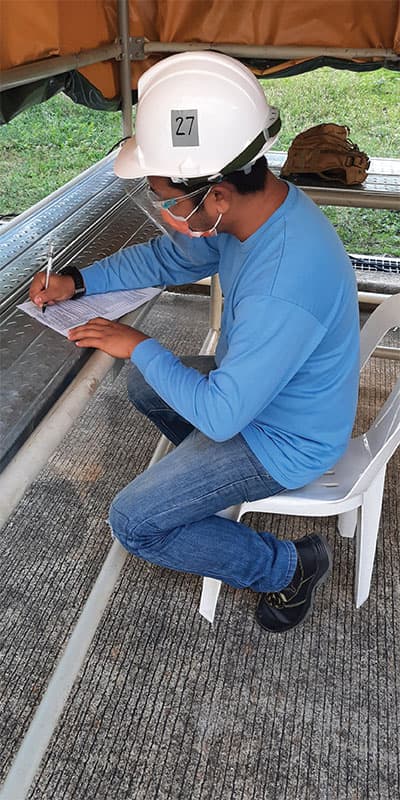
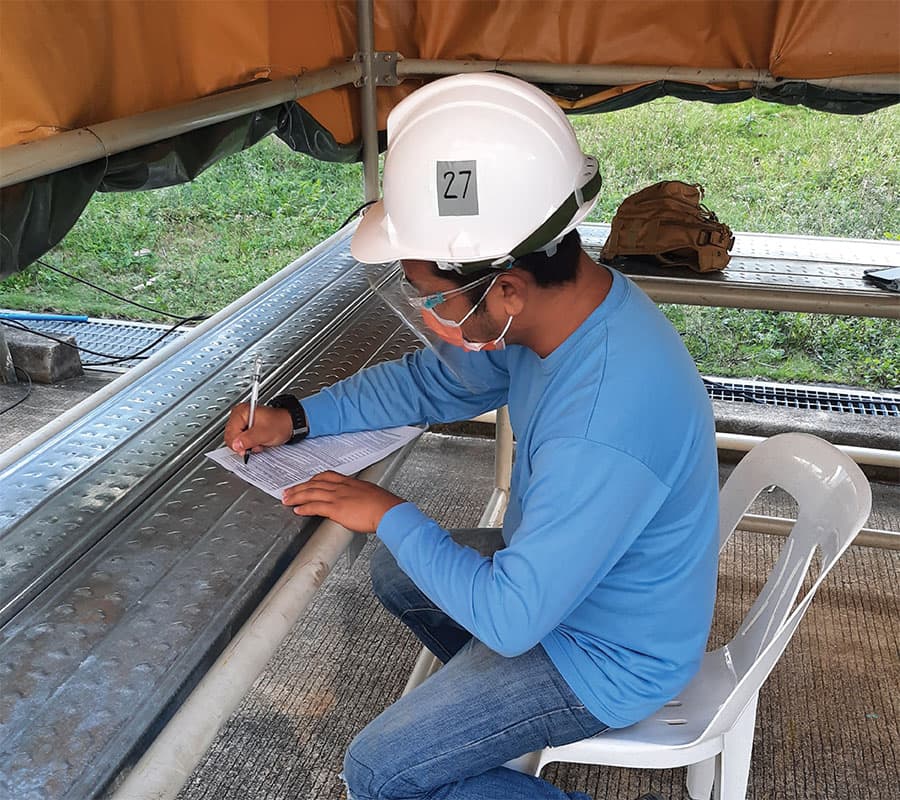
Worker answering the Health Declaration Form before entering the work site