
Economic Performance
Financial capital is composed of the Company’s sources of funds for use in the production of goods and the provision of services. It is managed based on maximizing stakeholder value by generating optimum economic and social outcomes.
The Company adopts strategies that increase financial returns and that avoid, mitigate, or rectify risks.
The process involved is reflected in the diagram that follows.
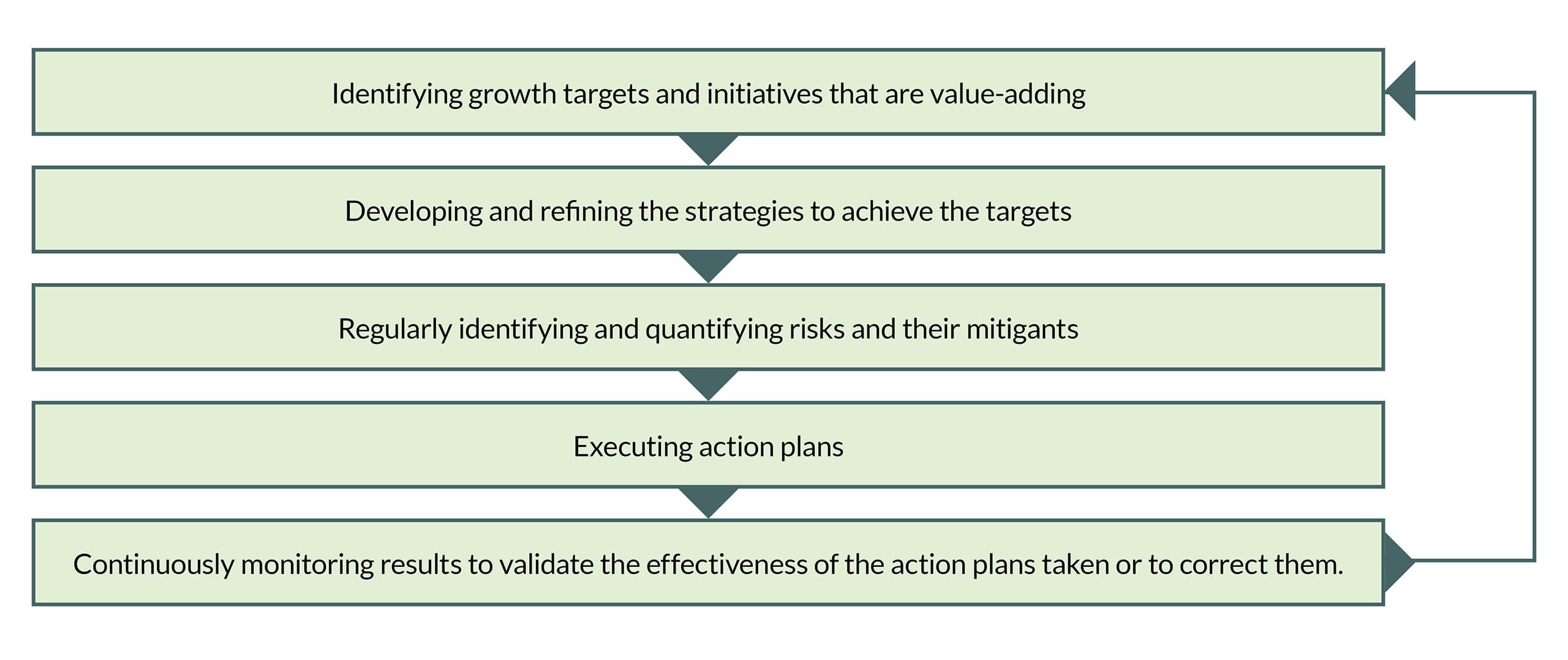
The Finance Department maintains financial models and conducts stress testing and scenario analyses to understand, quantify, and predict possible outcomes under adverse market conditions, and to strengthen the Company’s resilience against these scenarios. The Company maintains multiple credit lines to bolster liquidity and actively manages its debt obligations to support existing and new projects while ensuring a manageable repayment schedule.
Financial and operating results are reported on a quarterly, semi-annual, and annual basis through consolidated financial statements, which are prepared in accordance with Philippine Financial Reporting Standards that are effective at that time. The annual consolidated financial statements prepared by management are audited in accordance with the Philippine Standards on Auditing conducted by the independent external auditors duly appointed by the stockholders. The same annual consolidated financial statements are reviewed and approved by the Board of Directors prior to their disclosure to the public.
“The Company adopts strategies that increase financial returns and that avoid, mitigate, or rectify risks.”
Investor Relations
Investor trust and transparency are essential for a publicly-listed company such as First Gen. The Company, through its investor relations team, manages communications with all financial stakeholders with the following objectives:
- Define the Company’s corporate message, strategy, and objectives;
- Establish a consistent message;
- Provide timely information and updates to the Company’s stakeholders;
- Provide an avenue by which stakeholders can make known their complaints and concerns; and
- Build relationships of trust with stakeholders.
The Investor Relations team conducts meetings with existing and potential shareholders and responds to questions and requests in a timely manner. These are complemented by announcements, press releases, and public disclosures.
Feedback from stakeholders is important to the Company. As such, the Investor Relations team presents and communicates market and investor sentiment to Senior Management and to the Board, as applicable.
PANDEMIC RESPONSE
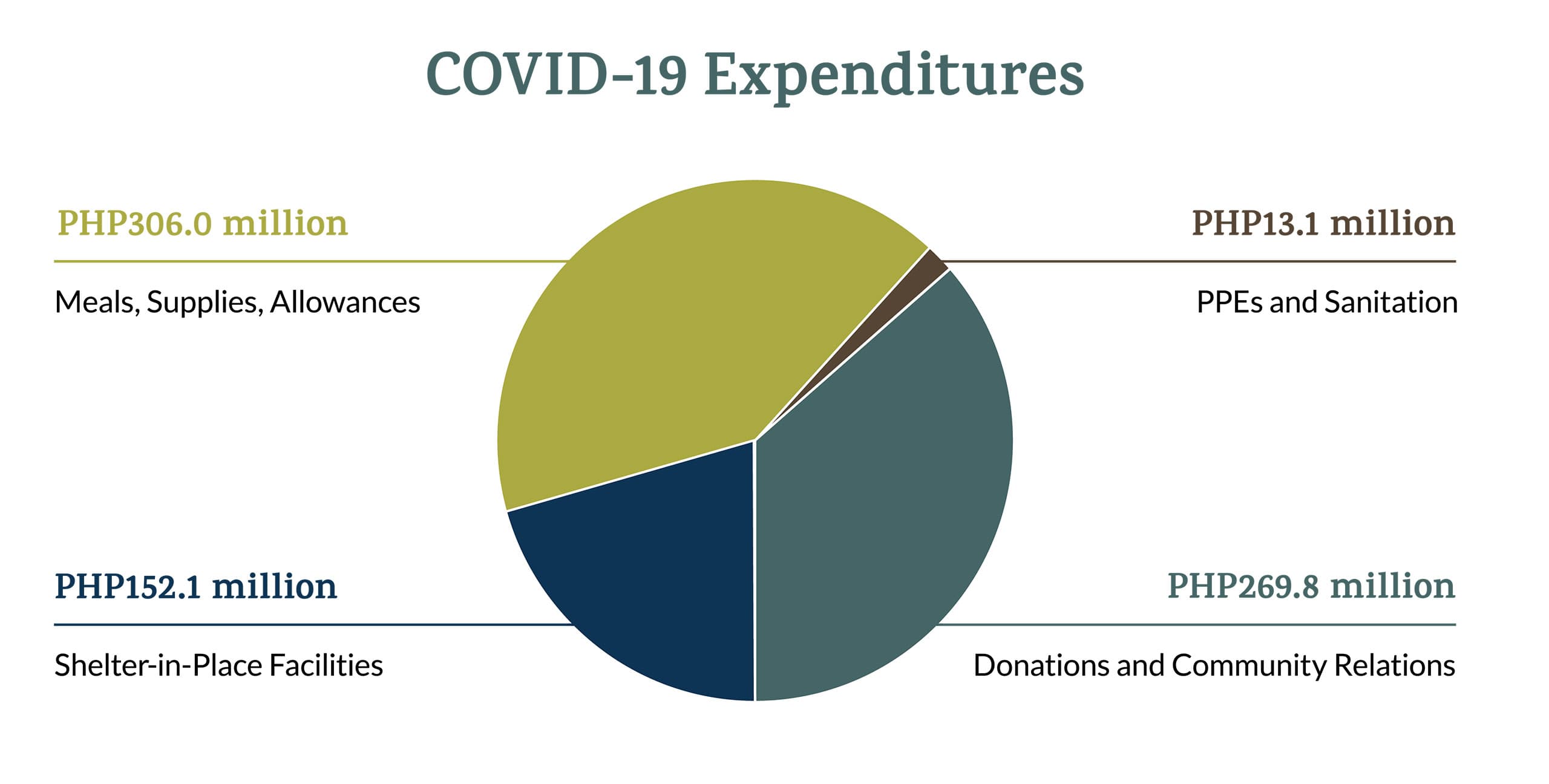
In response to the COVID-19 pandemic, First Gen invested in several programs to ensure the safety and welfare of its employees and local communities. These initiatives were vital to ensure that our power plants continued to operate reliably. The Company implemented a shelter-in-place protocol for mission-critical personnel and a work-from- home arrangement for the rest of its employees among other initiatives, which are detailed in the Business Continuity Management section of this report. In addition, the Company supported various pandemic-related efforts through its donations to the Government and its local communities.
In total, the Company’s expenditures and donations related to COVID-19 amounted to PHP741.0 million, which is broken down as follows:
DISTRIBUTION OF FINANCIAL CAPITAL
The Company started the year with long-term debt and shareholders’ equity amounting to USD1.9 billion and USD2.6 billion, respectively. As of December 31, 2020, these balances were at USD1.9 billion and USD3.0 billion, respectively.
The table summarizes the value the Company invest into its various capitals. We define these capitals with reference to the International «IR» Framework as “stocks of value that are increased, decreased, or transformed through the activities and outputs of the organization.” We present our financial capital that is transformed into the five other capitals, which includes accumulated investments over time for our manufactured, intellectual, and natural capitals and yearly allocated expenses for natural, human resource, and social and relationship capitals.
| CAPITAL TYPE | AMOUNT IN USD IN MILLIONS | ||
|---|---|---|---|
| 2020 | 2019 | 2018 | |
|
Manufactured Capital (e.g. property, plants, equipment, land development) |
1,845.5 | 1,753.8 | 1,917.5 |
|
Intellectual Capital (e.g. concession rights, intangible assets) |
36.0 | 46.2 | 54.4 |
|
Natural Capital (e.g. land value, environmental management programs) |
65.2 | 59.8 | 59.6 |
|
Human Resources (e.g. compensation, benefits, training) |
94.6 | 105.6 | 95.8 |
|
Social and Relationship Capital (e.g. corporate social responsibility, donations, and sponsorships) |
5.8 | 3.2 | 2.5 |
FINANCIAL OUTCOMES FOR 2020
Consolidated
In 2020, First Gen reported a recurring net income attributable to Equity Holders of the Parent amounting to USD252.1 million, an 11.4 percent decrease from the USD284.4 million in 2019. The decrease was primarily a result of softer spot market prices and lower sales volume due to lower electricity demand in 2020. The COVID-19 pandemic and the ensuing community quarantines disrupted industrial activity and commercial businesses, leading to a decline in electricity demand across the country. The impact of lower electricity demand and softer spot market prices, however, was moderated by First Gen’s high contracted levels, which tempered the Company’s exposure to the Wholesale Electricity Spot Market (WESM).
Cash flows were likewise affected at the start of the pandemic as the Energy Regulatory Commission (ERC) directed Distribution Utilities and Retail Electricity Suppliers to extend grace periods to their end-customers. Electricity bills which fell due within the Enhanced Community Quarantine (March 15 – May 15, 2020) were collected in four equal monthly installments thereafter. This, in turn, affected First Gen’s collections from its own customers.
The Company was able to weather this by maintaining a healthy cash buffer mainly as a result of its deleveraging program, which it started in 2016. The Company’s consolidated debt has steadily gone down in the past few years—from USD2.9 billion in December 2015 (3.2x Net Debt/ EBITDA) to a more manageable USD1.9 billion in December 2020 (1.5x Net Debt/ EBITDA). This has given the Company ample liquidity during the pandemic and the room to raise funding for its growth projects.
The financial performance of each platform is discussed in the next section.
Per Platform
| NATURAL GAS (PER PLANT IN USD MM) | ||||||||||||||||
|---|---|---|---|---|---|---|---|---|---|---|---|---|---|---|---|---|
| SANTA RITA | SAN LORENZO | SAN GABRIEL | AVION | |||||||||||||
| 2020 | 2019 | 2018 | 2020 | 2019 | 2018 | 2020 | 2019 | 2018 | 2020 | 2019 | 2018 | |||||
| Revenues | 584.3 | 704.5 | 681.9 | 296.0 | 352.3 | 341.7 | 171.5 | 248.1 | 199.4 | 20.5 | 34.7 | 17.0 | ||||
| Operating Income (Loss) | 143.6 | 151.0 | 152.1 | 71.1 | 71.3 | 72.8 | 42.1 | 50.1 | 49.6 | 1.3 | 5.6 | (2.5) | ||||
| Net Income (Loss) | 102.8 | 105.7 | 101.7 | 50.7 | 45.9 | 42.7 | 32.9 | 45.7 | 35.2 | 0.8 | 3.9 | (1.9) | ||||
| NATURAL GAS (TOTAL IN USD MM) | ||||||||||
|---|---|---|---|---|---|---|---|---|---|---|
| 2020 | 2019 | 2018 | ||||||||
| Revenues | 1,072.3 | 1,339.6 | 1,240.0 | |||||||
| Operating Income | 258.1 | 278.0 | 272.0 | |||||||
| Net Income | 187.2 | 201.2 | 177.7 | |||||||
The Natural Gas platform reported a net income of of USD187.2 million, a 7.0 percent decrease from USD201.2 million in 2019. The decrease can be attributed to the following:
- San Gabriel’s net income decreased by USD12.8 million due to the incurrence of replacement power cost resulting from the plant’s unplanned outage that began in September 2020, lower capacity fees during the Enhanced Community Quarantine period, and the expiration of its income tax holiday in April 2020.
- Avion’s net income decreased by USD3.1 million due to lower average selling prices and sales volume driven by lower electricity demand during the year. This was partially offset by higher revenues from ancillary services following the approval of its Ancillary Services Procurement Agreement (ASPA) contract with NGCP in May 2020.
- The gas plants likewise recognized one-time expenses in 2020 related to the Company’s COVID-19 programs and donations.
- The decrease was partially offset by the lower interest expenses of Santa Rita and San Lorenzo arising from lower benchmark rates and lower principal balances in 2020.
| GEOTHERMAL (IN PHP MM) | ||||||||||
|---|---|---|---|---|---|---|---|---|---|---|
| 2020 | 2019 | 2018 | ||||||||
| Revenues | 31,094.7 | 36,442.8 | 32,835.3 | |||||||
| Operating Income | 10,043.2 | 11,841.7 | 10,140.5 | |||||||
| Net Income | 8,764.6 | 11,075.6 | 8,212.1 | |||||||
EDC’s Geothermal platform earned PHP31.1 billion in revenues for 2020, a decrease of PHP5.3 billion or 14.7 percent from PHP36.4 billion in 2019.
The decrease can be attributed to the following:
- Lower spot market prices in 2020 as a result of the lower electricity demand during the year brought about by the pandemic
- Decrease in Negros and Bacman sales volume due to outages, including unplanned outages and pre-emptive shutdowns as precautionary measures for typhoons Quinta, Rolly, and Ulysses
- Decrease in Mindanao and Unified Leyte sales volume due to low steam supply during the year
The decrease in revenues was partially offset by lower operating expenses driven by lower operations and maintenance costs, personnel costs, consultancy fees, and taxes. In total, the Company’s geothermal platform posted a net income of PHP8.8 billion in 2020, 20.9 percent lower than the PHP11.1 billion in 2019.
| HYDRO (IN PHP MM) | ||||||||||
|---|---|---|---|---|---|---|---|---|---|---|
| PANTABANGAN-MASIWAY | AGUSAN | TOTAL | ||||||||
| 2020 | 2019 | 2018 | 2020 | 2019 | 2018 | 2020 | 2019 | 2018 | ||
| Revenues | 2,068.4 | 2,391.3 | 1,865.0 | 40.8 | 35.6 | 46.3 | 2,109.2 | 2,426.9 | 1,911.3 | |
| Operating Income (Loss) | 139.9 | 1,146.1 | 605.9 | (5.8) | (11.6) | 5.4 | 134.1 | 1,134.5 | 611.3 | |
| Net Income (Loss) | 112.0 | 1,058.3 | 509.7 | (5.5) | (10.2) | 5.0 | 106.5 | 1,048.1 | 514.7 | |
FG Hydro’s revenues amounted to PHP2.1 billion in 2020, a 13.5 percent decrease from the PHP2.4 billion in 2019. This decrease can be attributed to the following:
- Lower spot market prices in 2020 due to lower electricity demand during the year brought about by the pandemic
- Lower dam elevation and lower irrigation requirements from the National Irrigation Administration (NIA)1, which affected the plants’ generation and resulted in increased replacement power purchases
- This was partially offset by the commencement of FG Hydro’s 100-MW Power Supply Agreement with Meralco and higher ancillary services revenues on account of higher sales volume and average selling price
On the other hand, FG Bukidnon’s revenues increased by PHP5.2 million, or 14.6 percent to PHP40.8 million in 2020 from PHP35.6 million in 2019. The increase was driven by better water inflow and higher generation in 2020.
1 NIA generally determines the water releases from the Pantabangan and Masiway reservoirs based on the cropping cycle and irrigation requirements of the near-by rice fields
| WIND AND SOLAR (IN PHP MM) | ||||||||||
|---|---|---|---|---|---|---|---|---|---|---|
| BURGOS WIND | BURGOS SOLAR | SOLAR ROOFTOP | ||||||||
| 2020 | 2019 | 2018 | 2020 | 2019 | 2018 | 2020 | 2019 | 2018 | ||
| Revenues | 4,295.3 | 2,908.2 | 3,208.8 | 124.9 | 86.8 | 90.9 | 33.6 | 39.4 | 33.1 | |
| Operating Income | 2,764.6 | 1,366.0 | 1,696.6 | 78.7 | 39.2 | 42.5 | 12.5 | 16.3 | 20.7 | |
| Net Income | 2,011.6 | 692.0 | 990.5 | 64.4 | 24.1 | 27.5 | 10.0 | 12.5 | 15.2 | |
Burgos Wind posted a strong performance in 2020. Its net income increased significantly by 190.7 percent to PHP2.0 billion in 2020 from PHP692 million in 2019. The strong performance in 2020 can be attributed to the following:
- Recognition of the Feed-in-Tariff (FiT) rate escalation for its generation in 2016-2020, as approved by the ERC in May 2020. It was published for general circulation on November 17, 2020 and became effective 15 days later.
- Higher wind generation from a strong high wind season
Burgos Solar likewise recorded a significantly higher net income of PHP64.4 million in 2020, a 167 percent increase from the PHP24.1 million in 2019. The increase can be attributed to the following:
- Recognition of the FiT rate escalation for its generation in 2016-2020, as approved by the ERC in May 2020. It was published for general circulation on November 17, 2020 and became effective 15 days later.
- Higher generation as a result of lower down time in 2020
On the other hand, EDC Siklab’s net income decreased by 20 percent to PHP10.0 million in 2020 from PHP12.5 million in 2019. This was due to the lower demand of the Gaisano malls as a result of the community quarantine.